Clothing That Works With Your Body, Not Against It
Most people choose their clothing based on how it looks. We believe what you wear matters just as much as what you eat — because everything you put on your body has a direct effect on how you feel.
That is the story of natural and plant- based fibers. And it is why every piece we make is crafted exclusively from nature's finest yarns.
Everything Vibrates
Modern science has confirmed what ancient cultures understood intuitively — everything in nature carries a measurable energetic frequency, expressed in Hz (hertz). The food you eat, the water you drink, the air you breathe, and yes — the clothes you wear against your skin — all carry frequency.
The human body is no different. A healthy body resonates at approximately 62–78 MHz. When that frequency drops, we feel it — as fatigue, discomfort, reduced immunity, and a general sense of being off.
What surrounds us either supports our frequency or diminishes it.
The Frequency of What You Wear
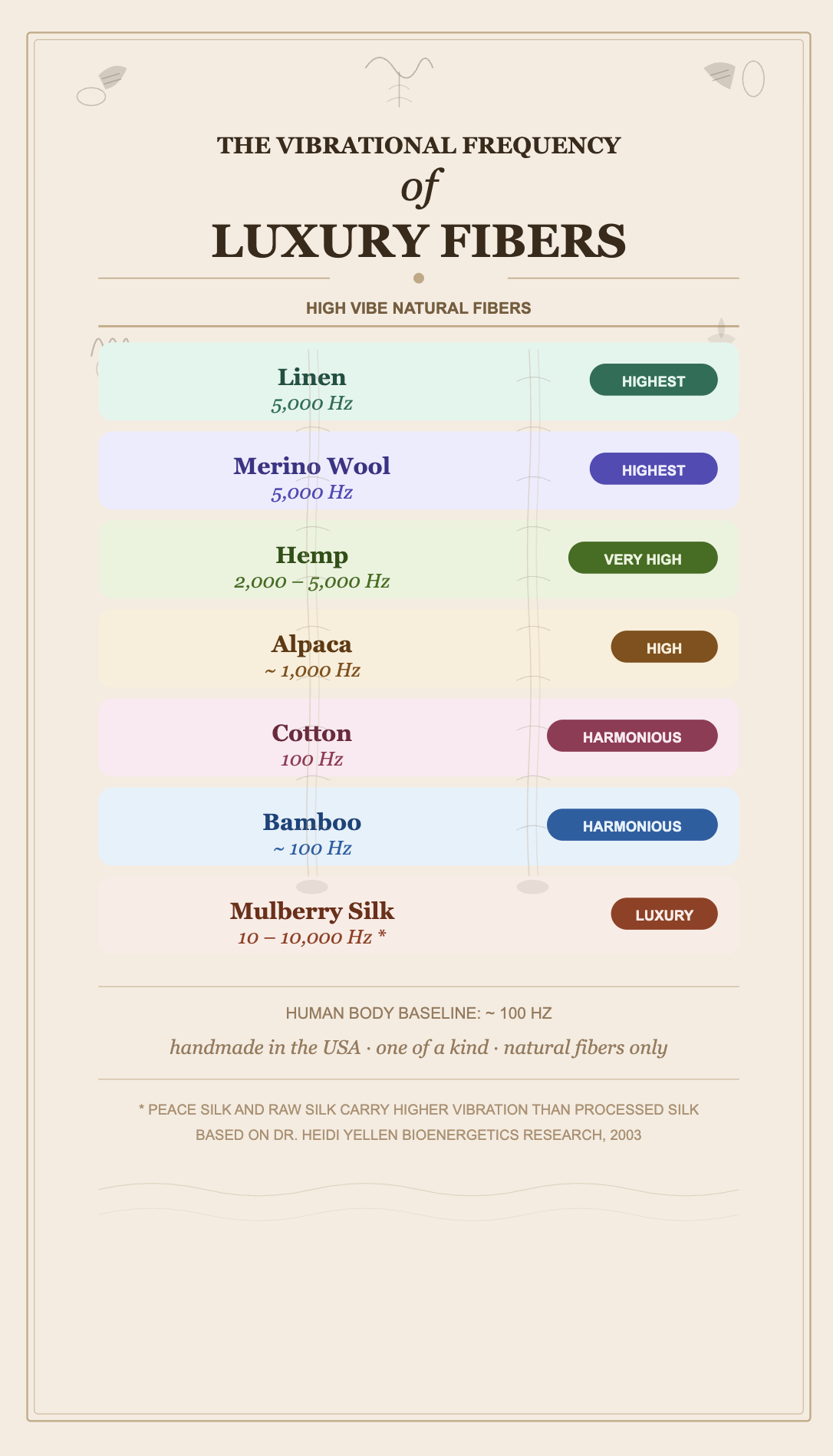
Researchers and natural health practitioners have measured the bioelectric frequency of common textile fibers. The results are striking:
Fiber Frequency:
Linen. 5,000 Hz
Wool & Merino 5,000 Hz
Hemp High — comparable to linen
Organic Cotton. 100 Hz
Linen — Nature's Highest Frequency Fiber
Linen has been revered across civilizations for thousands of years — worn by ancient Egyptian priests, used in sacred ceremonies, and prized in cultures around the world long before modern science could explain why.
Now we know. Linen's crystalline molecular structure creates a natural piezoelectric effect — it generates a gentle bioelectric charge when in contact with the body. This continuous resonance is believed to support the body's own energy field, promote calm, and enhance a sense of groundedness and wellbeing.
It is no coincidence that linen feels so different against your skin compared to synthetic fabrics. That difference is not just texture — it is frequency.
Merino Wool — Soft, Smart, and Alive
Merino wool is one of the most remarkable fibers in nature. Its ultra-fine protein structure — measuring as little as 15–18 microns in diameter — creates continuous gentle contact with your skin, resonating at approximately 5,000 Hz.
Beyond frequency, merino is a natural thermostat. It actively regulates your body temperature — warming when you are cold, cooling when you are warm. It wicks moisture naturally, resists odor, and softens beautifully with every wash. This is not engineering. This is nature doing what it has always done.
Hemp — Ancient, Powerful, and Pure
Hemp has clothed humanity for thousands of years across every culture and continent. Its fiber structure is remarkably similar to linen — dense, strong, and high frequency. Hemp softens with wear and washing, becoming more comfortable and more beautiful the longer you wear it.
It is also one of the most sustainable fibers on earth — requiring no pesticides, minimal water, and returning nutrients to the soil as it grows.
Cotton and Silk — Comfort and Luminosity
Organic cotton resonates at approximately 100 Hz — far above synthetic fibers and profoundly more comfortable for sensitive skin. Pima and organic cotton varieties carry the finest, softest fibers in the cotton family, feeling smooth and breathable against the skin through every season.
Silk adds a natural luminosity and fluid drape unlike any synthetic alternative. Its protein structure is biologically similar to human skin, making it one of the most skin-compatible fibers available.
Why We Choose Natural and Plant- Based Fibers
Every yarn we select — every merino, every linen, every cotton, silk, hemp, and plant-based fibers (viscose, bamboo) — is chosen not just for how it looks or how it knits, but for what it brings to the person who wears it.
We believe clothing should work with your body. It should support your energy, move with your natural rhythm, and feel like a second skin — not a barrier.
That is what natural fibers do. That is why we use nothing else.
Handmade in the USA • Natural Fibers • Crafted with Intention